
August 3, 2026
Gravity
Shipping friction holds good ideas down. Notes from my talk at Chain React 2026 on agents, React Native, and Expo — and why the only thing that makes you a builder is putting something in front of people.
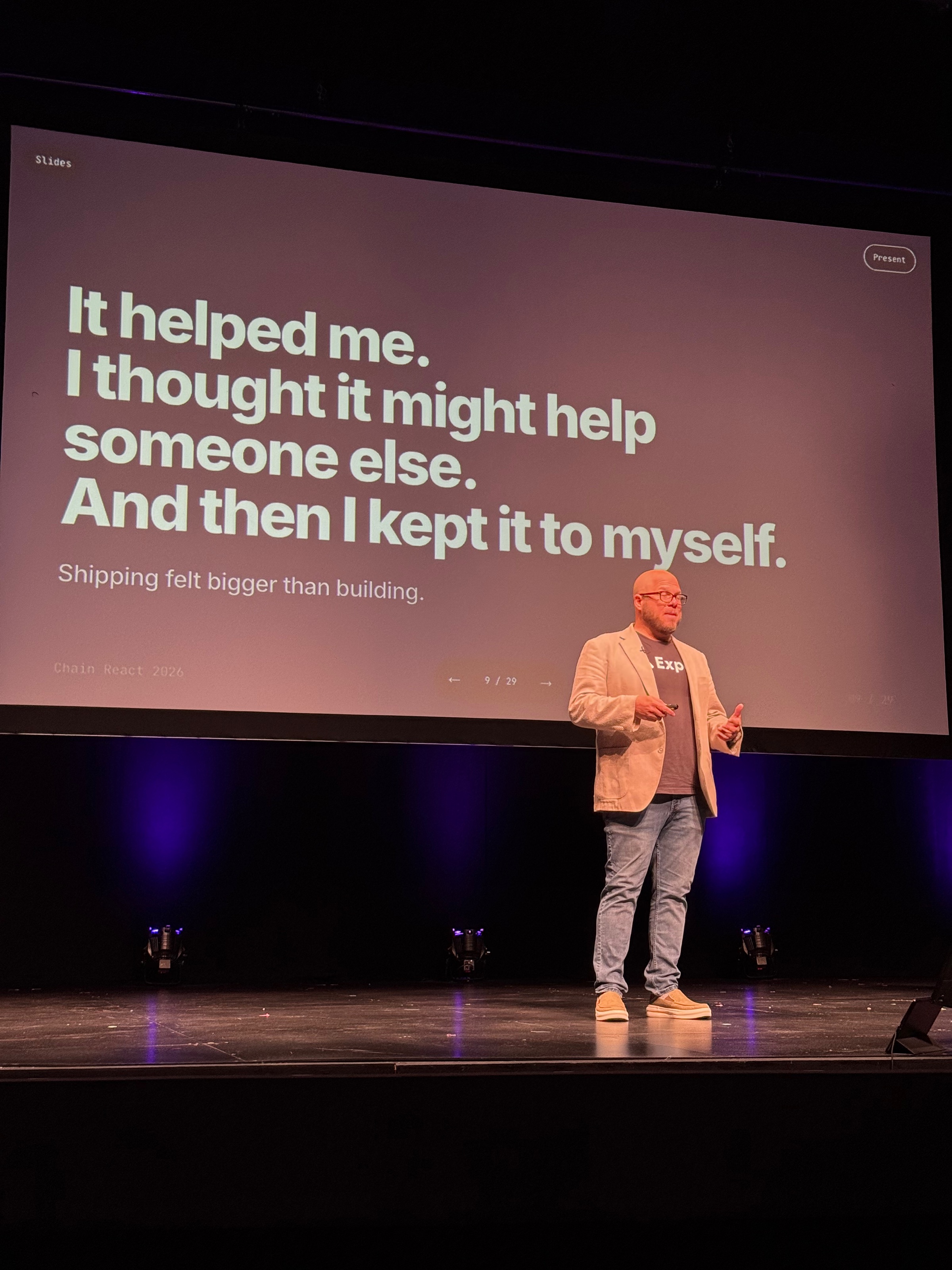
Notes from my talk at Chain React 2026
A few years ago, I started coming home from work with an irritated voice. Hoarse, tired, a little rough around the edges. I speak for a living — meetings all day, public talks, VC calls — so at first it didn't seem like much. That's just what happens when you talk too much.
But over the following weeks, the episodes got longer. And longer. Until one day I woke up and my voice was just gone. I couldn't manage more than a whisper.
What had actually happened was a mild case of COVID that, for reasons doctors still can't fully explain, caused brain damage. It left me with what they call long COVID, and out of that came a degenerative, permanent neurological condition called spasmodic dysphonia — the reason my voice breaks and shakes when you hear me talk today.
It's a strange thing to lose your voice when your voice is your job. I was a public speaker. I worked at Meta. I talked to people all day, every day. And the one tool I depended on most had just been taken away from me.
Two years of treatments
What followed was two years of the kind of treatment you don't expect to end up needing. Botox injections directly into my vocal cords — which, I promise you, do not feel good. Speech therapy, where I relearned how to say "apple" and "pineapple," where I recited poems about rainbows after giving talks like this one. Manipulation of my larynx, where a specialist would physically push it to the side, trying to unlock and coax my voice back. Laryngeal endoscopies I won't describe in detail.
Again and again and again, I went through these treatments and felt like I was getting nowhere. Some of that was just the grind of it — try running a VC call in a whisper. But a bigger part of the frustration was structural. I felt like there was a break in the system.
My ENT didn't know what my speech therapist was doing. My speech therapist didn't know what the laryngeal specialist was doing to my voice box. Everyone was listening to a piece of the problem, but nobody had the whole picture. Nobody could see the actual impact of what they were each doing to me.
When they injected my vocal cords with Botox, it took anywhere up to fourteen days — usually about six — for the effect to fully take hold. In that window, there were all kinds of small, specific things I experienced day to day that I'm sure would have been clinically interesting. Nobody was capturing them.
So I built something
I decided to try to fix this myself. I built an app. Every day, I recorded myself reading the same passages they had me read in speech therapy, and I rated my voice — difficulty, effort, perceived quality — on the same one-to-ten survey they used in the office.
Then I invited my whole care team into it: my ENT, my speech therapist, my laryngeal specialist. For the first time, they had a fuller picture. They could see the actual detail and timeline of the effects of the work they were each doing with me, all at the same time, from the same shared evidence.
It turns out we are all pretty unreliable witnesses, even to our own lives. When I'd sit down with my doctor and try to describe how the last few weeks had gone, I'd leave out huge amounts of detail — what happened on day three after the Botox, what changed after the fortieth time I said "happy little rainbow." One timeline. One shared set of evidence. That's what made the difference.
It worked. It worked well enough that when I showed it to my ENT, she got genuinely excited. She wanted to turn it into a field study — roll it out to her other patients, gather much more detailed and accurate reports paired with vocal evidence, and feed that into a model to understand, specifically and rigorously, what these treatments were actually doing.
And then I put it away and never followed up.
Why I never shipped it
It wasn't because building it was hard. Building was easy. Shipping was hard.
Certificates. Builds. Privacy policies. Launch landing pages. App review. All the things that come after the code is written. I was already under a mountain of stress from the condition itself, and the idea of taking on all of that on top of it felt like too much. So I just... didn't.
But it shouldn't have to be that way. Mobile is heavy. All of that friction — the certificates, the builds, the compliance, the review process — acts like a kind of gravity. It holds good ideas down. You run into one piece of friction, then another, and it compounds until you tell yourself, "I'll get to it later." And later never comes.
About 37,000 people a year are diagnosed with a vocal disorder like mine. My idea — something that could have helped a meaningful number of them, and their doctors, get better care — died on the pad. Not because it didn't work. Because shipping it felt impossible.
The three-stage rocket
That's the story I told at Chain React 2026, and it's the reason I think we're standing at one of the more remarkable moments in the history of software development.
Gravity is still there. It shows up at every stage of building something and getting it into the world. But right now, we're sitting on what I think of as a three-stage rocket that can push past it.
Stage one is agents. They collapse the distance between having an idea and having working software. What used to take weeks of scaffolding and boilerplate can now happen in an afternoon. The idea gets on the screen faster than it's ever been possible to get it there.
Stage two is React Native. Once you have that software, React Native lets you put it in someone's pocket — on iOS, Android, and increasingly Windows, macOS, tvOS, even Linux and visionOS — at the same time, with apps that are, for most people, indistinguishable from native. That parity wasn't there a few years ago. It's there now. And there's something genuinely intimate about that: someone choosing your app and carrying it around with them, in their pocket, all day.
Stage three is Expo, which is a big part of why I joined the company. Expo is obsessed — genuinely, structurally obsessed — with removing the friction between developers and shipping. We spend our careers building delightful experiences for our users. Expo is a company built to give that same care to us.
Agents, React Native, and Expo together make it possible to go from idea to something real in someone's hands faster than at any point I've seen in this industry. I think we are living through the greatest developer empowerment moment in the history of technology — genuinely more capable of doing more with less than we have ever been.
What 36 hours can do
There's a story I love about a company called Zoe. Back at the start of the pandemic, they had a prototype app for tracking nutrition. As COVID started getting bad, they realized they could repurpose that groundwork to help understand the disease itself — get it into people's hands, let them log symptoms, and learn from it while the information still mattered. Two years later would have been too late.
They rewrote it and shipped it. Thirty-six hours from the first line of modified code to the app being in people's hands. Within a week, more than a million people had joined. That app is part of the reason we learned that losing your sense of taste and smell was one of the earliest signs of COVID infection.
Thirty-six hours, and it changed the science. Apple's review process today wouldn't let that timeline happen anymore — but it's worth sitting with what's possible when the distance between idea and impact gets that short.
The new baseline
Every week now, we see demos of things people one-shotted with an agent. That's the new baseline. It's genuinely impressive — a good demo can get people to join you, can get you funding, can open doors. But it isn't special anymore, because almost anyone can produce one.
What's special is sticking with it. What's special is being brave enough to take that thing all the way — past the demo, through app review, out into other people's hands, with your name attached to it, ready for the criticism and the complaints that come with anything real. If you've ever shipped something people use, you know: some of them will love it, some of them will complain about it, and it's usually the same people. That's the job. Putting something in front of people is the only thing that actually makes you a builder.
Raise the ceiling
So here's what I'd ask: don't spend this new capacity building the same size things we've always built. We have more leverage than we've ever had. Use it to be more ambitious, not just more efficient.
Build the thing that feels a little too big. Build the thing that scares you a little — that's usually a sign it matters. Whether your idea is meant for three people or three million, build for the full reach it deserves. There is genuinely less excuse than ever not to.
And to be clear: none of these tools make you a builder. You already are one if you're the kind of person willing to see an idea through. These tools give you power. They don't decide how far you go. You do.
A builder, to me, is someone who goes all the way — who doesn't let the roadblocks stop them, who doesn't let app review or a privacy policy or a certificate wear them down, who carries an idea all the way through until it has the impact it was meant to have.
I'm a builder. Build, learn, ship, repeat.
I'll be your first customer.